
Thailand’s Telecom Regulator Keeps Growing While Competition Collapses

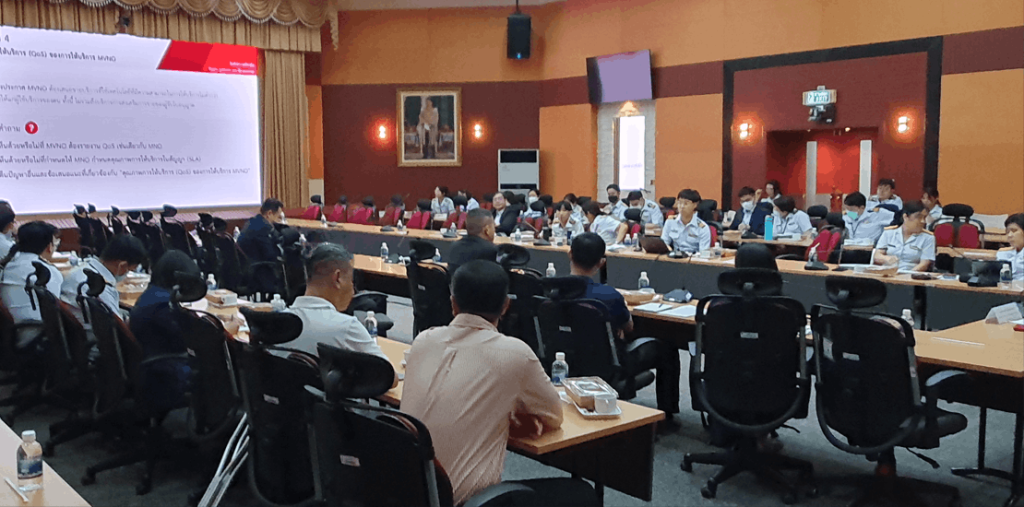
Headquarters of Thailand’s Telecom Regulator – National Broadcasting and Telecommunications Commission (NBTC) in Bangkok.
Thailand’s telecom regulator is facing mounting criticism over rising budgets, expanding bureaucracy, and failure to stop market consolidation as Parliament openly questions the agency’s future.
During a heated parliamentary session in May 2026, lawmakers from both the government and opposition described the National Broadcasting and Telecommunications Commission (NBTC) as “standing accused by society” after years of failed consumer protection, telecom consolidation, ballooning bureaucracy, and mounting public frustration.
The accusations came alongside findings from the Office of the Auditor General showing unusually large unused budget reserves, weak oversight mechanisms, damaged state assets, questionable travel spending, and strategic projects with limited measurable outcomes.
At the center of the controversy lies a deeply uncomfortable question: why has Thailand’s telecom regulator continued growing in budget, staffing, and administrative complexity while the market it regulates has steadily shrunk into an effective duopoly?
The Disappearance of the Thai Telecom Sector
To fully appreciate the absurdity of the NBTC’s expansion, one must look at the wreckage of the market it left behind.
Over the 2021–2025 period, Thailand transformed from a highly vibrant, competitive digital economy into one of the most consolidated telecom environments in Southeast Asia.
In 2020, Thai consumers could choose between five Mobile Network Operators (MNOs): AIS, True, dtac, and the two state-owned operators CAT Telecom and TOT.
In 2021, the two state enterprises (CAT and TOT) were merged into National Telecom (NT).
The True-dtac Merger and the Collapse of Competition
By 2023, following the NBTC’s controversial decision to “acknowledge” rather than approve or block the blockbuster merger of True and dtac, the market was slashed to an effective duopoly.
Today, AIS and True control roughly 99% of all mobile subscriptions. National Telecom remains structurally invisible to the average consumer.
The Mobile Virtual Network Operator (MVNO) sector experienced an even worse fate. Supposed to act as a competitive safety valve, the NBTC historically issued over 65 virtual network licenses on paper.
In reality, the commercial MVNO market in Thailand effectively collapsed because the regulatory foundation supporting them was actively dismantled.
Historically, state-owned NT was the only host operator actually hosting active MVNOs. The sector was effectively wiped out when the NBTC permitted NT to stop hosting these virtual networks altogether, a move accelerated when the regulator auctioned off NT’s vital spectrum assets directly to the duopoly of AIS and True.
Meanwhile, the private giants have kept their networks entirely closed to outside competition. For more than a decade, a mandatory regulatory rule has dictated that network operators must reserve a minimum of 10% of their network capacity for MVNOs.
This rule was heavily reinforced three years ago as a strict, legally binding condition for the True-dtac merger. Despite these explicit legal frameworks, both AIS and True have completely ignored the mandate, flatly refusing to open up and provide network access to any virtual operators.
True simply never gave access despite the explicit merger conditions, and the NBTC has stood by, failing to levy any meaningful penalties or legally compel the duopoly to comply.
The fixed broadband market mirrored this exact consolidation trap when AIS finalized its multi-billion-baht acquisition of 3BB, reducing national consumer fiber options to a tight trio.
Even digital terrestrial television, which launched with 36 channels in 2014, has buckled under financial stress. Following a continuous wave of returned licenses and high-profile station closures, the number of highly active, mainstream national commercial and public channels has plummeted to 19.
Table 1: The Shrinking Thai Communications Market (2016–2026)
The Protected Bureaucracy: Budget and Staff Isolation
One might assume that an agency supervising zero MVNOs, a five-to-two consolidated mobile duopoly, and only half of the original commercial TV stations would require less capital and fewer administrative hands.
Instead, the exact opposite has occurred.
The NBTC’s annual expenditure budget has consistently hovered between 5.1 billion and 6.7 billion baht ($157 million – $206 million) over the past five years.
A Regulator Shielded From Market Contraction
Because the NBTC is an “independent” state agency, it does not rely on taxpayer money from the central government’s national budget.
It funds its own operations by retaining a massive chunk of the billions generated from spectrum auctions, telecom numbering allocations, the auctioning of “VIP Phone Numbers”, and corporate licensing fees before handing the remainder to the State Treasury. This self-funding mechanism has shielded the regulator from standard austerity measures.
The agency’s spending footprint over the last five years illustrates this insulation:
Table 2: NBTC Annual Budget and Spending Commitments (2021–2025)
Rising Staff Numbers and Personnel Costs
Even more glaring is the agency’s staffing trajectory. While the private sector consolidated operations, and laid off thousands of employees to maximize dividends and shareholder value, the NBTC’s workforce grew from 1,719 personnel in 2020 to more than 2,100 persons in 2025.
Chart: Total NBTC Headcount 2021 – 2025
The cost of this large workforce is also very high. During the debate in the Parliament, lawmakers pointed out that the average monthly salary for these employees is 52,700 baht ($1,634).
To put this in perspective, the national average monthly salary in Thailand is approximately 15,700 baht ($487), and even entry-level civil servants typically earn far less than this average. This high pay for the entire organization suggests that the agency is using its status as an independent body to provide corporate level wages for government level performance.
On top of these payroll costs, the agency spent 212 million baht ($6.57 million) for outside consultants in 2023. These expensive contracts have not helped the agency work better. Instead, they have been used to build a larger organization of managers and staff, focusing more on internal administration than on its real job of regulating the telecommunications industry.
A staggering 45% to 50% of the entire annual operational budget, totaling 2,676 million baht in 2025 alone, ($82.44 million) is believed to be consumed strictly by personnel expenses, executive bonuses, and staff benefits. In 2023, that figure was 2,160.16 million baht ($66.55 million).
The agency supports 47 distinct internal bureaus, an expansive management hierarchy including a Secretary-General, numerous Deputies, and Assistant Secretaries-General, alongside a vast network of provincial spectrum-monitoring outposts.
Rising Compensation Costs Amid Market Contraction
While the Thai telecommunications market has withered into a rigid duopoly, the financial lifeblood of the National Broadcasting and Telecommunications Commission (NBTC) has flowed inward rather than toward the public good.
The agency’s 2025 expenditure reports reveal substantial spending on staff and executive compensation even as competition in the telecommunications market continues to contract.
Most notably, the NBTC’s spending on end-of-service and retirement benefits ballooned to 579.70 million baht ($17.57 million) in 2025, nearly tripling the 200.32 million baht ($6.07 million) spent the previous year.
Remuneration for the Seven Commissioners
Beyond general staff compensation and retirement benefits, the NBTC reported remuneration expenses of 180.72 million baht ($5.48 million) in 2025.
This budget consisted of 25.15 million baht ($760,000) in commissioner remuneration, 35 million baht ($1.06 million) in meeting allowances, and 120.57 million baht ($3.65 million) classified as “other remuneration.”
The largest component of this budget is a broadly defined “other remuneration” category, which accounts for approximately 67% of the total remuneration allocation. The financial statements provide no detailed public breakdown explaining the composition of these payments.
If the entire 180.72 million baht remuneration budget is attributable solely to the seven NBTC commissioners, it would imply an average annual compensation cost of approximately 25.82 million baht ($780,000) per commissioner.
Under that assumption:
- Fixed remuneration would equal approximately 3.59 million baht ($110,000) per commissioner.
- Meeting allowances would equal approximately 5.00 million baht ($150,000) per commissioner.
- “Other remuneration” would equal approximately 17.22 million baht ($520,000) per commissioner.
The “other remuneration” category alone would therefore account for roughly two-thirds of each commissioner’s implied annual compensation.
Combined, these internal costs represent a significant institutional commitment to personnel maintenance at a time when the agency has presided over the total collapse of the MVNO sector and the consolidation of mobile services into an effective duopoly.
By decoupling its financial survival from the economic health of the sector, the NBTC has transformed into an organization that appears to function primarily as an employer-centric entity, insulating its leadership and workforce from the same market pressures that have left Thai consumers with higher costs and fewer choices.
The Illusion of Regulatory Theatre
How does an organization justify a growing workforce and a multi-billion-baht operating budget in a market that has largely engineered its own structural monopolies? The answer lies in what global compliance experts and international bodies call “Regulatory Theatre.”
Rather than enforcing rigid antitrust parameters or acting to compel network access, the NBTC has repeatedly pivoted toward administrative projects that create the illusion of intense regulatory activity. When criticized for presiding over market decay, the commission points to its expansive slate of newly funded initiatives:
- Crafting localized artificial intelligence ethical frameworks.
- Formulating Over-The-Top (OTT) platform regulations for international streaming apps.
- Restructuring type classification systems for regional data centers.
- Managing municipal underground cabling transitions.
While these administrative actions sound progressive on paper, critics point out that they successfully distract from the core failures of infrastructure oversight.
Legislators pointed to the True-dtac merger and the subsequent rise in consumer costs as evidence that the agency is failing its mandate and has become susceptible to influence by large capital groups.
Independent consumer reports throughout 2025 and 2026 revealed a sharp uptick in consumer complaints, with over 80% of surveyed users reporting degraded mobile data speeds, dropped calls, and rising package prices following the True-dtac merger.
The App, Systems, and Database Facade
To make matters worse, a substantial portion of the projects funded under the guise of modernization involves building internal electronic systems.
The NBTC routinely secures praise in internal performance audits for launching new electronic licensing portals, sleek mobile applications, and updated databases. In theory, these expensive software upgrades were supposed to streamline administrative workflows, eliminate red tape, and dramatically reduce the need for excessive bureaucratic staffing.
Instead, the exact opposite has happened. The rollout of these has served as an excuse to build an even larger empire of internal managers, technicians, and supervisory layers to oversee the code, rather than executing the actual work of regulation.
The agency collects points from internal committees simply because a website or a PDF database exists, transforming a tool for efficiency into a justification for hiring more personnel.
The regulator has effectively replaced enforcement with IT development. The office is highly active in constructing digital systems, yet entirely paralyzed when it comes to utilizing those systems to penalize non-compliance or break open an anti-competitive market. The watchdog has spent its resources watching its own computer screens rather than watching the operators.
Luxury Travel and Unfinished Headquarters
Further illustrating this internal operational detachment is the ongoing 1.8-billion-baht ($55.47 million) legal battle with Power Line Engineering Plc over the construction of the NBTC’s “new” massive, multi-building headquarters in Nonthaburi.
The project has dragged on for over seven years, plagued by design changes and administrative delays, standing as a physical monument to bureaucratic inertia.

The Chairman’s Overseas Travel Controversy
Compounding this culture of internal insulation is the chronic controversy surrounding the lavish overseas travel expenditures by the NBTC Chairman.

While local consumers struggle with rising subscription costs and dwindling options under an unregulated duopoly, the NBTC Chairman’s individual travel habits have become a focal point of public and parliamentary controversy.
Reports highlighted a specific instance of 15 premium international trips undertaken by the Chairman, incurring costs totaling 45.8 million baht ($1.41 million).
This pattern of high-rolling executive travel has drawn sharp criticism from state auditors and public interest groups alike, underscoring an organization far more focused on internal executive privileges than the grueling, ground-level work of enforcing antitrust laws.
Parliamentary Scrutiny and Audit
The administrative insulation of the NBTC has now moved from public criticism to formal scrutiny within Parliament.
During the Parliament session on May 21, 2026, the Office of the Auditor General (OAG) presented findings that show deep problems in how the agency manages its money and internal operations. These results validate long-standing concerns about the organization’s lack of transparency and financial health.
Auditor General Findings
The OAG audit revealed that the NBTC keeps much more money than it needs. For more than a decade, the agency has maintained central budget remainders that exceed 80% every year.
Furthermore, in 2023 the NBTC’s internal pension fund had accumulated a surplus of 1,005 million baht ($31 million), far exceeding the 162.13 million baht ($5 million) required for payouts between 2024 and 2026.
These findings show that the agency is not working efficiently. In 2023, the agency launched 58 strategic projects, but only six of them used clear quality standards to measure success.
Internal audits also found that over 50% of the agency’s assets (about 2,680 items) were either broken, worn out, or missing.
Additionally, the agency spent 86.51 million baht ($2.67 million) on international travel in 2023, but it failed to provide the necessary documents to prove that the flight prices were reasonable.
Calls to Dissolve the NBTC
The response from lawmakers in Parliament was very critical. They described the NBTC as standing accused by society over its failure to protect consumers, noting that for 16 years, the agency has failed to stop monopolies or protect consumers.
The debate reached a point where lawmakers suggested the organization might need to be dissolved and replaced with a new one.
Furthermore, the NBTC faces significant, unacknowledged financial exposure. Lawmakers identified active legal disputes totaling over 63 billion baht ($1.94 billion), a massive liability that remains notably absent from the NBTC’s official financial reports. This omission creates a significant hidden risk to the public, as a negative outcome in these legal battles could force the agency to seek state assistance to cover the resulting financial burden.
A Lesson in Regulatory Capture
The trajectory of the NBTC over the last years serves as a stark warning about the dangers of institutional self-preservation. When an oversight body builds a self-funding shield that decouples its financial survival from the economic health and competitiveness of the market it manages, true accountability vanishes.
Thai consumers are currently paying a duopoly tax via higher monthly bills, limited service plans, and diminished corporate alternatives. Meanwhile, the agency built to protect them sits comfortably inside an expanding administrative apparatus, secure in the knowledge that no matter how small the commercial market shrinks, the regulatory empire will keep growing.


Latest MVNO News


LET’S TALK MVNO
If you have any questions, please fill out the form and a member of our team will get in touch with you. We are always open for talks on how we can add value to your MVNO.